
For most people, a 25 mm (1 inch) barrel is the safest all-round choice. It gives classic curls on shoulder-length to long hair. Go down to 13 to 19 mm for tight, defined curls or short hair, and up to 32 to 38 mm for looser curls and soft waves, according to Plate and Curl’s barrel size guide. The rest of this guide helps you match the number on the box to the finish you want.
TL;DR
- The bigger the barrel, the looser the curl. Smaller barrels make tighter curls.
- 25 mm (1 inch) is the best first size for most hair lengths. Choose 13 to 19 mm for short hair or tight curls, and 32 to 38 mm for long hair and waves.
- Between two sizes? Pick the smaller one. A tight curl can be brushed out, but a loose curl can’t be tightened once it drops.
- Fine, straight hair that won’t hold a curl usually does better with a slightly smaller barrel and lower heat.
Table of Contents
- Why barrel size matters
- Curling iron sizes in mm and inches
- Choose by the look you want
- Choose by hair length
- Choose by hair type
- The rule that saves wasted curls
- Technique can change the result as much as size
- Prep and protect before you curl
- Our perspective
- Other tools that shape curls
- Shop salon-grade care for heat styling at ProHair
- Quick answers by situation
- FAQ
- Sources
Why barrel size matters
The barrel is the part your hair wraps around, so its diameter sets the shape of the curl. A thin barrel bends the hair into a small, tight loop. A wide one makes a gentle bend that reads as a wave.
Hair length matters just as much. A 38 mm barrel on chin-length hair barely wraps once, so you get a bend rather than a curl. A 13 mm barrel on hair well past your shoulders can take ages and gives a tight, ringlet-like finish that may not be what you pictured.
Research from the same guide puts it simply: for short, chin-length hair, 13 to 19 mm barrels tend to work best, while hair that sits well past the shoulders suits 32 to 38 mm for waves.

Curling iron sizes in mm and inches
Brands list barrels in millimetres, inches, or both. The maths is easy: 1 inch is 25.4 mm, and manufacturers round to a handful of standard sizes. Here is the chart most people need.
| Barrel (mm) | Barrel (inches) | Curl result | Best for |
|---|---|---|---|
| 13 mm | ½" | Tight spirals, ringlets | Short hair, afro-textured or very curly looks, defined curl detail |
| 19 mm | ¾" | Tight, bouncy curls | Short to medium hair, fine hair that drops curls |
| 25 mm | 1" | Classic curls with bounce | Shoulder-length to long hair, the all-rounder |
| 32 mm | 1¼" | Looser curls, relaxed waves | Medium to long hair, volume |
| 38 mm | 1½" | Soft, beachy waves | Long hair, blowout-style bends |
If you see a 25 mm wand called a “1 inch”, that is the same tool. A 26 mm or 28 mm barrel falls between sizes, so treat it as the nearest one in the chart.
Choose by the look you want
Tight spirals and ringlets: 13 to 19 mm
These are the smallest barrels, and they make the most defined, springy curls. They are also easier to handle on short hair, as there is enough length to wrap but not so much that the curl hangs in a heavy column.
One caution: tight curls look dramatic straight off the iron. Brushing them through with your fingers or a wide-tooth comb softens them into a fuller, rounder shape.
Classic, bouncy curls: 25 mm
This is the size that suits the widest range of people. On shoulder-length hair it makes a polished curl that still looks like hair. On longer hair it gives a looser, more voluminous result. If you only want to own one barrel, this is it.
Loose curls and waves: 32 to 38 mm
These wider barrels are for long hair and a relaxed finish. They work well for a soft, “just left the salon” bend. They need length to show up, so on hair above the shoulder they can disappoint.
Choose by hair length
- Chin-length or shorter: 13 to 19 mm. Anything larger will mostly add a bend at the ends.
- Shoulder-length: 19 to 25 mm. Use 19 mm for tighter curls and 25 mm for a classic finish.
- Mid-back or longer: 25 to 38 mm. Longer hair weighs a curl down, so a wider barrel often looks more natural, and a 25 mm still gives a good curl if you like more definition.
Thinking in three zones helps. Short hair gets small barrels, medium hair gets the middle, and long hair gets the choice of anything from 25 mm up.
Choose by hair type
Curl hold depends on your hair’s texture and your technique, not only the barrel. Stylists quoted by Real Simple point out that a 1-inch iron is versatile across lengths, and smaller barrels suit tighter curls or enhancing natural waves, especially on shorter hair.
Fine or straight hair. It tends to relax quickly. Going one size smaller than you think you need helps make up for it. Fine hair also burns more easily, so keep the temperature as low as still gives you a curl. Our straightener temperature guide explains how to find your lowest safe heat, and the same thinking applies to curling tools.
Thick or coarse hair. It usually holds a curl well but needs smaller sections. A 25 to 32 mm barrel with sections about the width of the barrel gives an even result.
Natural waves or curls. You may only need a tool to even out patches. Read our guides on a wavy hair routine and a complete curly hair routine to get the base right before heat comes into it.
Colour-treated or damaged hair. Heat is the main stress here, so pick the size that gets you the shape in one pass rather than redoing sections. A heat protectant is a must, and we cover it below.
The rule that saves wasted curls
If you are torn between two sizes, take the smaller. Curls relax over the day, so starting tighter gives you longevity. A tighter curl can be brushed out into something looser and more natural, but a curl that starts too loose can’t be tightened again once it falls.
That is also why it is better to buy a mid-range size first and learn how your hair behaves than to jump straight to a 38 mm wand because beach waves look good online.
Technique can change the result as much as size
A few habits change what the same barrel does:
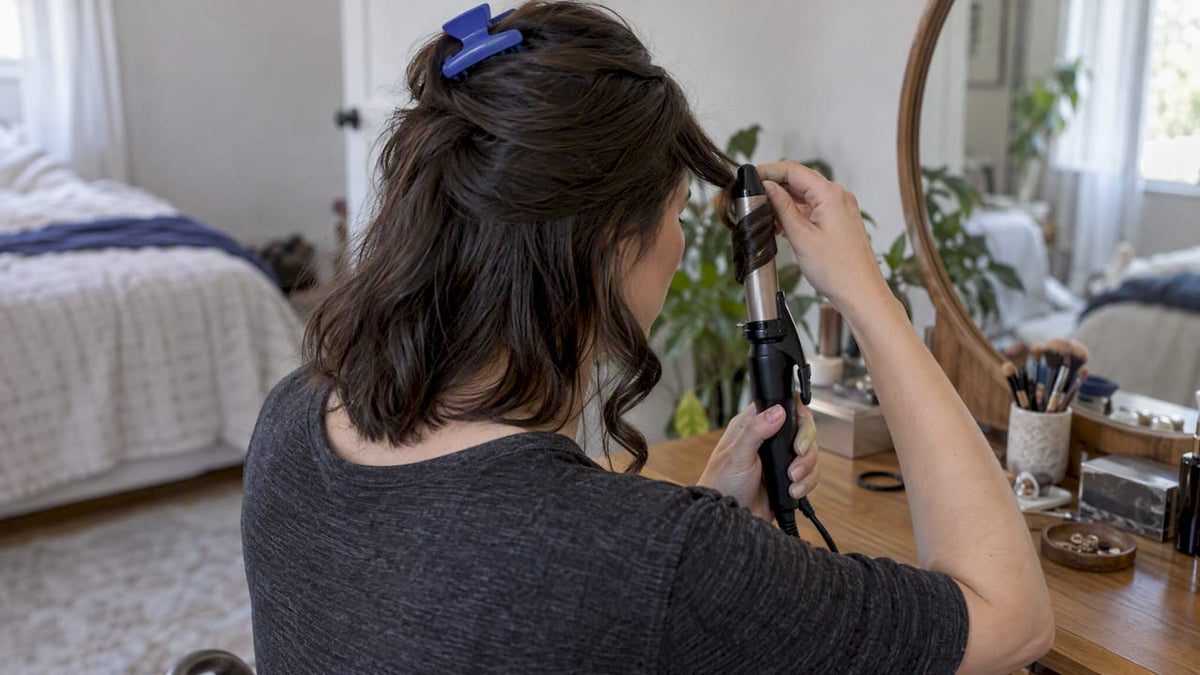
- Section your hair. Small sections curl evenly. Big ones leave a bend on the outside and a straight layer underneath.
- Leave the ends out. Keeping the last few centimetres outside the barrel gives a modern, lived-in finish rather than a pristine ringlet. Stylists recommend this for an effortless look.
- Let the curl cool. Don’t brush or touch it until it has cooled. Warm hair is still pliable and will fall flat.
- Mix directions. Alternating the direction of the wrap from one section to the next gives a less uniform, more natural result.
If you are still deciding between tools, our piece on when to use a curling wand or iron on fine hair covers the difference between clamp and clamp-free styles.
Prep and protect before you curl
Barrel size sets the shape, but the condition of your hair sets how good it looks. Dry or brittle ends frizz and fray under heat, and a curl on dry hair loses its shine.
Before styling, start with hair that is completely dry. Curling damp hair is one of the quickest ways to cause heat damage. Then apply a heat protectant evenly and comb it through. Our heat protection range is designed for exactly this step.

If you are working with tight curls on short hair, ends can get the driest. A smoothing or filling treatment in the days before styling helps. For example, a hair fill-up ampoule treatment sold in 13 ml single-use sizes is one way people give dry lengths a boost before using a smaller barrel.
Our perspective
We talk to salons across New Zealand every day, and the most common mistake we hear about is not damage or heat. It is buying the wrong size and giving up on the tool. Someone buys a 38 mm wand for shoulder-length hair, gets a gentle bend that drops in an hour, and decides curling “doesn’t work” on their hair.
Our advice is simple. Start with 25 mm unless your hair is very short or you know you want tight curls. Learn how long your hair holds a curl, then move up or down a size. And treat heat styling as part of your routine rather than a weekly rescue: protect, style at the lowest effective temperature, and give your hair a conditioning treatment between sessions.
If you’d rather skip heat on some days, our guide to heatless curls overnight gives you six options that let your hair rest.
— Burgs
Other tools that shape curls
A curling iron isn’t the only way to add shape. Blowout brushes work on a similar principle: the diameter of the brush sets how tight or loose the bend is. Our extra long ceramic and ionic vent brushes come in 32 mm, 45 mm and 53 mm sizes, so you can match the size to your hair length in the same way. Smaller suits shorter hair and more curl, larger suits longer hair and a smooth, bouncy blowout.
To hold a finished curl, a light styling product helps. Davroe Styling Crème offers flexible hold for all hair types, and works well for defining without stiffness.
Shop salon-grade care for heat styling at ProHair
Good curls start before the iron. At ProHair, we supply products trusted by over 500 salon accounts across New Zealand, and you can get the same professional formulas at home. Browse our professional hair tools, treatments for repair and hydration and styling and finishing products. Shipping is free on orders over $100, sent from our local warehouse.
Quick answers by situation
- Short bob, want a defined curl: 19 mm.
- Shoulder-length, everyday curl: 25 mm.
- Long hair, soft waves: 32 to 38 mm.
- Fine hair that drops curls: go one size smaller than your first choice, and lower the heat.
- Not sure at all: 25 mm.
FAQ
What size curling iron is best for beginners?
A 25 mm (1 inch) barrel is the best starting point. It suits shoulder-length to long hair, makes classic curls, and is forgiving if your technique is still developing. You can brush the curls out for a looser finish.
How long is a 25 mm curling wand in inches?
A 25 mm barrel is about 1 inch, since 1 inch equals 25.4 mm. Other common conversions are 13 mm to ½ inch, 19 mm to ¾ inch, 32 mm to 1¼ inches and 38 mm to 1½ inches.
Which barrel size is best for waves?
For soft waves on long hair, choose 32 to 38 mm. On medium-length hair, 25 to 32 mm gives a relaxed wave. If waves fall out quickly, step down one size and brush them through once cool.
Which size is best for short hair?
Choose 13 to 19 mm. Larger barrels don’t have enough hair to wrap, so you end up with a bend rather than a curl. A 19 mm barrel is a good middle ground between tight and bouncy.
Sources
- What size curling wand should I get? Barrel sizes explained, Plate and Curl
- Curling wand barrel size converter: mm to inches, Plate and Curl
- How to Pick the Right Curling Iron Size for Your Curl Goals, Real Simple