
Yes, some haircare products contain intentionally added microplastics, and certain synthetic polymers can behave like them once rinsed down the drain. The main worry is environmental release, not absorption through your scalp. Read the ingredient list for polymer names, favour products that state they are microplastic‑free or use natural abrasives, and go easy on abrasive rinse‑off scrubs.
TL;DR:
- Flagged names such as polyethylene, polyamide, and acrylates copolymer warrant scrutiny, but ask whether each is an insoluble particle or a water soluble ingredient.
- One shampoo analysis detected particles from about 10 μm to 2,085 μm, but differing filters and confirmation methods make study counts difficult to compare.
- Large polyethylene particles have limited absorption through skin, while wastewater treatment captures only some particles before the rest can reach waterways.
- Use abrasive rinse off scrubs no more than weekly, and less often if your scalp is sensitive; a clarifying shampoo may address product buildup more gently.
Table of Contents
- What are microplastics in haircare, and why do formulators use them?
- Which haircare products contain microplastics?
- How can you spot microplastic ingredients on a label?
- What does the research show about how common microplastics in haircare are?
- Is the concern about health or the environment, and what are regulators doing?
- What alternatives do formulators use instead of microplastics?
- What is a simple checklist for buying and using haircare with less plastic?
- How do laboratories test shampoo and conditioner for microplastics?
- What does this mean for choosing salon‑grade products?
- FAQ
- Sources
What are microplastics in haircare, and why do formulators use them?
Microplastics are plastic particles smaller than 5 mm. In cosmetics, the term covers two groups. Primary microplastics are added on purpose, such as the polyethylene beads once common in scrubs. Secondary microplastics form when larger plastic items break down over time, which is more of an environmental story than a formulation one. The European Commission’s microplastics page describes them as persistent, mobile and hard to remove once they reach the environment, which is why regulators care so much about the intentionally added kind.
What do they actually look like? A laboratory study of rinse‑off shampoo samples, Isolation, quantification, characterization, and risk intake of microplastics from rinse‑off shampoo, found particle sizes from about 10 μm up to 2,085 μm. That is a huge spread: the smallest are invisible to the eye, while the largest are the size of a grain of sand or bigger. The same study recorded a mix of fibres, irregular fragments and spherical beads, and its spectroscopy identified polymers including polyacrylate, polyamide and polyester in some samples.
So why would a formulator reach for plastic in the first place? The reasons are practical.
- Thickening: synthetic polymers give a shampoo or conditioner body, so it sits on your palm instead of running through your fingers.
- Conditioning and film forming: some polymers coat the hair shaft, smoothing the surface and adding shine or hold.
- Exfoliating: solid beads buff the scalp or skin in scrubs.
- Sensory feel: polymers can change slip, cushion and the way a product spreads.
Here is the nuance that matters. Not every polymer is a solid particle. Many are water‑soluble or exist as liquids, and those are a different proposition from a hard bead. The trouble is that a label rarely tells you which is which, so you need a little ingredient literacy, and we cover that further on.
Hair is personal, and so is the way you care for it. You do not need a chemistry degree to choose well. You need to know that “polymer” can mean very different things, that size and solubility drive the environmental concern, and that a growing number of formulators are moving to alternatives. Knowing the basics lets you ask better questions of any brand, including us.
It also helps to separate the two worries that often get blended together. One is whether the particles do anything to you. The other is whether they end up somewhere they should not be. For most haircare, the second question is where the real discussion sits, and the sections below take them one at a time.
Which haircare products contain microplastics?
Rinse‑off products are the biggest focus. Exfoliating scrubs historically used polyethylene microbeads, and review studies have reported high particle counts in some scrubs and exfoliants. Certain shampoos have also been found to contain particles, though results vary widely between products. The 2024 review Microplastics in Cosmetics: Open Questions and Sustainable Opportunities pulls together prevalence data and the open questions the industry still has to answer.
Leave‑on and styling products are a different case. Think of gels, mousses, hairsprays, serums and leave‑in conditioners. These often contain synthetic polymers acting as film formers and thickeners. They are not abrasive beads, and many are not particles at all. Some, though, are insoluble and may persist in the environment, so they deserve a closer look on the label rather than a blanket judgement.
Why does the rinse‑off versus leave‑on split matter so much? It comes down to the pathway.
Rinse‑off products are designed to leave your hair almost immediately. Whatever is in the bottle, including any particles, heads straight down the shower drain and into wastewater. Treatment plants remove a portion, but not everything, and the remainder can reach waterways and eventually marine environments. That direct route is why scrubs and rinse‑off cleansers drew the earliest regulatory attention.
Leave‑on products mostly stay on your hair until the next wash. Some residue still gets rinsed off later, and some is shed through brushing, washing clothes and bedding, so they are not a clean bill of health. But the release is slower and more diffuse than the instant drain flush of a scrub.
It is worth keeping the categories in perspective:
- Exfoliating scrubs are the products most associated with intentionally added beads.
- Shampoos and conditioners sit in the middle: some contain polymers, many do not contain solid particles at all.
- Styling products lean on film‑forming polymers, whose environmental behaviour depends on whether they dissolve.
A practical point for shoppers: format can change the picture. A solid shampoo bar, for example, often has a different ingredient makeup from a liquid. If you are curious, our guide to shampoo bars versus liquid shampoo explains how the two compare for different hair types.
The takeaway is not that every product on your shelf is a problem. It is that the products most likely to deserve scrutiny are the abrasive rinse‑off ones and anything whose ingredient list leans heavily on unexplained polymers.
How can you spot microplastic ingredients on a label?
Start with the INCI list, the standardised ingredient names printed on the pack. Brands rarely write “microplastic” on a label, so you are looking for the chemical names that point to synthetic polymers. Guidance and industry appendices commonly flag the following.
- Acrylates copolymer and acrylates/C10‑30 alkyl acrylate crosspolymer
- Polyacrylamide
- PEG‑14M and PEG‑23M
- Polyethylene
- Polyamide
- Polyester
- PVM/MA copolymer
A resource such as the Microplastics App guide to shampoo and conditioner notes that Acrylates Copolymer, Polyacrylamide and PEG‑type compounds turn up frequently in shampoos and styling products, and that they could manifest as microplastics in some formulations.
Now the ambiguous part. Words like “copolymer” and “polymer” on their own tell you very little. A polymer can be a liquid, a gel, a water‑soluble chain or a hard insoluble particle, depending on the exact material and how it is formulated. That is why the presence of a flagged name is a prompt for a follow‑up question, not a verdict. The EU’s wider restriction targets insoluble synthetic polymer microparticles that persist in the environment, which tells you the key variable is solubility and particle form, not the name alone.
There are three practical label signals worth building into your habits:
- A clear “microbead‑free” or “microplastic‑free” claim, ideally backed by an ingredient list that supports it.
- Ingredient transparency, meaning the brand lists everything and explains unfamiliar entries.
- A willingness to answer questions when you contact them directly.
Pro Tip: If a polymer name is unfamiliar, email the brand and ask one specific question: “Is this ingredient a water‑soluble polymer or an insoluble solid particle?” A good brand will answer plainly.
We cover the basics of decoding ingredient lists in our own guide on how to read shampoo labels, which walks through what to look for before you buy. It pairs well with the checklist later in this article.
One more habit: do not rely on the front of the bottle. Marketing words such as “natural” or “clean” are not regulated in a way that guarantees the absence of synthetic polymers. The back label is where the facts live. Spend a little time scanning it and you will quickly learn which names you want to look up.
What does the research show about how common microplastics in haircare are?
The honest summary is that findings vary a lot. Studies of personal care products report wide heterogeneity in particle counts, sizes and polymer types, and the numbers depend heavily on which products were tested and how. Some analyses report that microplastic counts vary across personal care items, particularly exfoliating products, while many other products show far fewer or none.
The shampoo study from the Polytechnic University of Bucharest team is a useful reference point. In that work, rinse‑off shampoo samples contained particles ranging from about 10 μm to 2,085 μm, in the form of fibres, irregular fragments and beads, and micro‑FTIR mapping identified polymers such as polyurethane, polyester, poly(methyl methacrylate), polyamide and polyacrylate in some samples. Fibres made up a large share of particles in at least one of the studies reviewed in this area, which is a reminder that not every microplastic in a bottle is a neat little bead.
Study finding: laboratory analysis of rinse‑off shampoo found particles from about 10 μm up to 2,085 μm in a mix of fibres, fragments and beads. That spread shows how varied a single product category can be.
How do researchers actually find these particles? The usual toolkit includes optical microscopy to see and measure particles, Nile red staining to make plastic particles fluoresce so they are easier to spot, and micro‑FTIR spectroscopy to confirm which polymer a particle is made of. Shampoo is a tricky sample because it is a dense mix of surfactants, oils, silicones and other organic material that can mask or mimic plastic, so isolating particles takes careful preparation. We walk through that workflow in the laboratory section below.
How should you read these numbers? With some caution:
- A high count in one scrub does not describe every product in a category.
- Different methods can find different things, so two studies are not always directly comparable.
- Counts show that particles can be present and that products vary. They are not a single, definitive measure of risk.
The 2024 review in PMC reaches a similar place: the field has open questions, including standard methods and the real‑world fate of particles, alongside a clear direction of travel toward sustainable alternatives. For you as a shopper, that means treating the research as evidence of presence and variability rather than as a score you can apply to a particular shampoo.
It is also worth noting what the research does not say. It does not show that using a typical shampoo harms your hair or scalp. The more established concern is what happens after the product goes down the drain, which is where the next section picks up.
Is the concern about health or the environment, and what are regulators doing?
These are two separate questions, and the evidence is stronger for one than the other.
Health. The toxicology picture for the classic cosmetic microplastic is reassuring on the skin side. The Cosmetic Ingredient Review’s final report on the safety assessment of polyethylene notes that polyethylene used in cosmetics is generally considered safe for dermal application, because the polymer particles are large enough that systemic absorption through the skin is limited. In other words, the main issue with a polyethylene scrub is not what it does to you, but where it goes afterwards.
Environment. This is the policy driver. After you rinse, particles travel into wastewater. Treatment plants capture some but not all, and what escapes can accumulate in waterways and marine environments. The European Commission explains that microplastics are persistent and hard to remove, and its approach targets intentionally added microplastics, unintentional releases and primary sources such as pellet loss. The 2024 PMC review also frames environmental persistence as the central open concern for cosmetics.
Regulation. The direction has been steadily tightening. The EU’s REACH restriction adopted in 2023, set out on the European Commission’s REACH restriction page, broadened the focus from plastic microbeads alone to a wider range of intentionally added, insoluble synthetic polymer microparticles that persist in the environment. That matters because it captures more than the obvious scrub bead.
For shoppers in New Zealand, the relevant framework is the Environmental Protection Authority’s Cosmetic Products Group Standard. According to the New Zealand legislation page, the standard aligns with EU Regulation (EC) No 1223/2009 for banned and restricted components, and record‑keeping requirements for nanomaterials were updated. Microplastic labelling is handled within these broader chemical safety frameworks rather than through a dedicated “microplastic” label, which is one more reason ingredient reading is worth the effort.
Put together, the picture is balanced. There is no strong evidence that the large polymer particles in cosmetics pass through intact skin in meaningful amounts, but there is solid, consistent concern about what accumulates in the environment. That is why regulators have focused on release rather than on a haircare‑specific health warning, and why we think the sensible response is practical: choose well, rinse less abrasively, and ask brands good questions.

What alternatives do formulators use instead of microplastics?
The shift away from plastic beads has been underway for years, and the replacements are mostly familiar ingredients. An industry overview from Global Cosmetic Industry describes formulators swapping synthetic polymers for natural or biodegradable options such as cellulose and silica derivatives, while brands put more weight on ingredient transparency and certifications to avoid hidden synthetic polymers.
Common alternatives include:
- Cellulose: plant‑derived beads or fibres that give body or gentle exfoliation.
- Jojoba beads: soft, wax‑based spheres used in scrubs.
- Ground shells and seeds: natural abrasives with a coarser, more rustic feel.
- Sugar and salt: dissolve in water, so they leave nothing behind.
- Silica derivatives: mineral‑based texture and absorbency.
- PLA (polylactic acid): a bioplastic that can biodegrade under certain conditions.
Each comes with trade‑offs. PLA is the clearest example. It is biodegradable, but usually only under specific conditions, and it can bring formulation challenges such as colour stability and pH effects. Natural abrasives can feel different on the skin and scalp: a ground seed is not the same as a smooth bead. Sugar and salt are effective but can be messier to formulate, as they dissolve and change a product’s texture over time.
What does this mean for you as a customer? Expect some difference. A scrub made with natural abrasives may look less uniform, feel slightly coarser or be less glossy than its plastic predecessor. That is not a flaw; it is the nature of the material. Brands have to work to optimise the formula so that performance holds up, which is why transparent claims matter more than marketing language.
If you are looking more broadly at sustainable personal‑care choices, the ideas overlap with other categories too. Our friends at Urban Caps have a handy read on what makes headwear sustainable, and it is a good example of how the same questions about materials and care apply well beyond haircare.
When you shop, look for brands that explain what replaced the plastic, not just that they removed it. A simple statement such as “we use jojoba beads instead of polyethylene” is far more useful than a vague “eco‑friendly” badge.
What is a simple checklist for buying and using haircare with less plastic?
You do not have to overhaul your routine in one go. A short checklist covers most of what matters.
At the shop
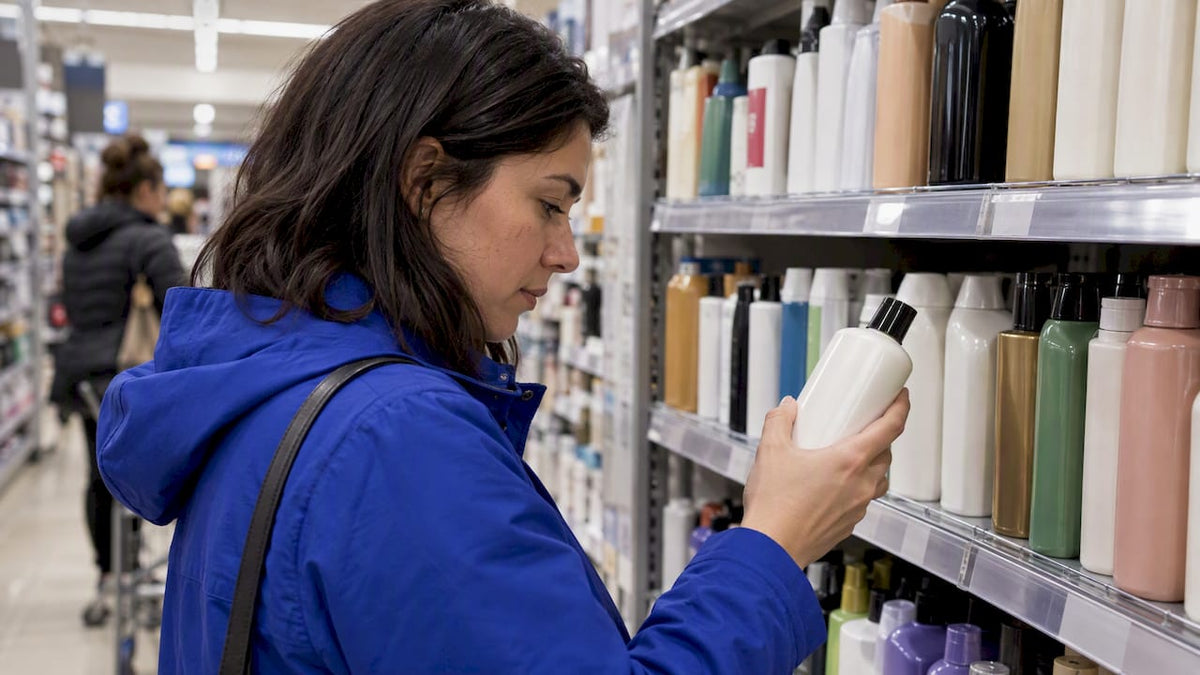
- Scan the INCI list for the flagged polymer names covered earlier, and look up anything you are unsure about.
- Prefer products with a clear microplastic‑free or microbead‑free claim that the ingredient list supports.
- Choose natural or water‑soluble abrasives (sugar, salt, cellulose, jojoba) when you want exfoliation.
- Favour brands that are open about their formulas and happy to answer questions.
- Where a shampoo bar or other format suits your hair, consider it as an alternative to a heavily polymer‑based liquid.
At home
- Use abrasive rinse‑off scrubs less often. Once a week is plenty for most people, and less if your scalp is sensitive.
- Fit a hair trap over your shower drain. It catches loose hair and anything clinging to it, and it keeps your plumbing happier too.
- If product build‑up is the reason you reach for a scrub, think about whether a clarifying shampoo would do the job more gently. Our explainer on clarifying versus detox shampoo lays out the difference.
What to ask a brand
- Is this polymeric ingredient a water‑soluble polymer or an insoluble particle?
- Are the abrasives in your scrub biodegradable?
- Do you list every ingredient, including those in fragrance and colour?
Pro Tip: Keep a note on your phone of two or three polymer names you want to avoid. Checking the label in the aisle takes seconds once you know what to look for.
None of this requires perfection. The aim is simply to nudge your choices in a better direction, one product at a time. Small, repeated decisions across many households add up, and they also send a clear signal to brands about what shoppers want.
If you are replacing a product anyway, it is a natural moment to switch. Our shampoo and conditioner collection is a good place to browse salon‑grade options, and our treatments collection covers repair and hydration for the hair types we hear about most.
How do laboratories test shampoo and conditioner for microplastics?
Understanding the lab workflow helps you judge why one study’s numbers do not match another’s. The typical process runs in a handful of steps.
- Sample preparation. The product is treated with digestion or solvent steps to break down the organic matrix of oils, surfactants and other ingredients so that any plastic particles are left behind.
- Filtration. The treated sample is passed through a filter that captures particles above a certain size.
- Staining. Nile red dye is applied so plastic particles fluoresce and stand out under the microscope.
- Microscopy. Particles are counted, measured and sorted by shape: fibre, fragment or bead.
- Spectral confirmation. Micro‑FTIR spectroscopy checks the chemical fingerprint of individual particles to confirm which polymer they are, or to rule out look‑alikes.
The hard part is the matrix. Shampoos and conditioners are complicated mixtures, and non‑plastic particles such as waxes, silicas or undissolved ingredients can be mistaken for plastic. Staining alone can also flag organic material, which is why spectral confirmation is essential. The Bucharest shampoo study relied on micro‑FTIR mapping to identify its polymers rather than on visual inspection alone.
This explains much of the variation you will see between reports. Different digestion methods, different filter pore sizes and different detection limits will find different particles. A study with a coarse filter will miss the smallest fragments, while one that skips spectral confirmation may overcount. So when you read a headline figure, it is fair to ask how the particles were found and confirmed before leaning on the number.
What does this mean for choosing salon‑grade products?
When I look at this topic, what stands out is how much of the confusion comes down to labels. The environmental concern is real, and I would not wave it away. But the practical gap for most shoppers is not a lack of caring; it is a lack of clear information at the shelf. A polymer name on a pack tells you almost nothing about whether it is a soluble liquid or a hard particle, and that is a problem the industry could solve with plain explanations.
My view is that the best response is not fear but clarity. Prioritise brands that explain their INCI entries, say what replaced any plastic, and are happy to answer a direct question. Then choose salon formulations that balance performance with sustainability, because a product that does not work gets used more, discarded sooner and replaced more often, which is its own kind of waste.
That is the spirit in which we stock and talk about products at ProHair. We would rather you understand what is in your bottle than take our word for it. Start with our guide to reading shampoo labels, use the checklist above, and bring us your questions.
— Burgs
FAQ
Which shampoos do not contain microplastics?
Shampoos that state they are microplastic‑free and list natural or water‑soluble ingredients instead of insoluble synthetic polymers are a practical option. No single list covers every product, so check the INCI list yourself. Our shampoo and conditioner collection is a good starting point for salon‑grade options.
Which beauty products have microplastics?
Rinse‑off exfoliating scrubs are the products most associated with intentionally added microbeads. Some shampoos, styling products and other cosmetics also contain synthetic polymers that can behave like microplastics depending on their form. The 2024 PMC review of microplastics in cosmetics covers the range of products and open questions.
Does CeraVe contain microplastics?
We cannot answer for another brand’s formulas, and ingredients change between products and over time. The reliable method is to read the current INCI list on the pack for flagged polymer names and, if unsure, ask the manufacturer whether any polymer is an insoluble particle.
Is vaseline a microplastic?
No. Petroleum jelly is a semi‑solid mixture of hydrocarbons, not a solid plastic particle, so it is not classed as a microplastic. It is derived from petroleum, which is a separate environmental conversation, but it does not fit the microplastic definition of a solid particle under 5 mm.
Sources
- ISOLATION, QUANTIFICATION, CHARACTERIZATION, AND RISK INTAKE OF MICROPLASTICS FROM RINSE-OFF SHAMPOO
- Legislation
- Single-market-economy
- Final report on the safety assessment of polyethylene
- Microplastics in Cosmetics: Open Questions and Sustainable …