
Start with once a week. That’s the safest baseline for most blondes and light-haired people managing brassiness, and many of us find once or twice a week is plenty to keep tones cool without drying hair out. From there, adjust based on how porous your hair is, how strong your formula is and how fast brassiness creeps back. Always follow the label, and ease off if you notice irritation or persistent dryness.
TL;DR:
- Highly porous, bleached, or fragile hair may need purple shampoo only every 2 to 4 weeks because it absorbs pigment faster and holds it longer.
- Photograph your hair in natural light during a four to six week trial, then increase to twice weekly only if brassiness persists without dryness.
- Apply shampoo to midlengths and ends first, then follow the label; a starting time of one to three minutes can limit violet staining.
- Pause toning if hair turns rough, frizzy, or violet; clarify once, condition deeply, and skip purple shampoo for several washes while it recovers.
- Skip purple shampoo during the week before a color appointment, because leftover toner can interfere with how your stylist’s color formula develops.
Table of Contents
- Practical frequency guidance and example schedules
- How hair type, colour level and porosity change how often you should tone
- How to apply purple shampoo without over-toning or drying hair out
- Signs of overuse and how to fix them fast
- Aftercare and scheduling around salon appointments
- ProHair product examples for a safe starter routine
- Combining purple shampoo with other toning products and treatments
- Seasonal or environmental factors affecting usage frequency
- Trusting a gentle, test-and-adjust approach
- Where to find salon-grade toning shampoo and conditioner
- FAQ
- Sources
Practical frequency guidance and example schedules
Most of us do well with purple shampoo occasionally, or as often as every other week. That’s usually enough to counteract yellow and orange tones without stripping colour or moisture from the hair shaft. If brassiness is stubborn, somewhat more frequent use might help, but it should be approached cautiously rather than as a default.
Very pale, porous or fragile hair (think freshly lightened, heavily bleached or chemically treated strands) often needs far less: once every 2 to 4 weeks can be enough, because porous hair grabs pigment faster and holds onto it longer. Experts recommend starting conservatively and adjusting based on how your hair actually responds, not on a fixed schedule.
A simple 4 to 6 week starter protocol takes the guesswork out of it:
- Week 1 to 2: use once a week, and take a photo in natural light each time so you can track real changes rather than relying on memory.
- Week 3: if brassiness is still visible and hair feels healthy, move to twice weekly; if hair feels tighter, drier or rougher, stay at once weekly.
- Week 4 to 6: hold your chosen frequency and keep assessing. If tone stays cool and hair stays soft, you’ve found your rhythm.
The decision between more frequent and less frequent use comes down to two signals. Visible brassiness without dryness means you can safely use purple shampoo a little more often. Dryness, frizz or a rough feel, even with some brassiness still showing, means you should pull back and let conditioning treatments do more of the work. Whatever schedule you land on, stick to the contact time printed on the bottle. Formulas vary in strength, and the label reflects how that specific product was designed to behave on hair.
How hair type, colour level and porosity change how often you should tone
Porosity is the biggest variable in how often you should reach for purple shampoo. Highly porous hair, which is common after bleaching or repeated colour treatments, absorbs pigment faster and more unevenly than healthy, low-porosity hair. That means the same product can act stronger on porous strands than it would on virgin hair, so cutting back on both frequency and contact time helps avoid overcorrection.
A simple way to check porosity at home is to look at how a strand behaves in water: hair that sinks quickly tends to be more porous and absorbent, while hair that floats is less porous and processes toner more slowly. Our guide to testing hair porosity walks through the method step by step if you want a clearer read on your own hair before you commit to a schedule.
Colour level matters too. Hair with subtle highlights usually needs less toning than hair that’s been fully bleached, because the untouched sections don’t pick up warmth the way lightened sections do. Full-head blondes and balayage with heavy lightening tend to need more consistent toning to stay even.
- Damp, brittle or visibly dry hair should use purple shampoo less often, with more focus on hydrating conditioners and treatments between washes.
- Watch for excessive frizz, breakage or a straw-like texture: these are cues to pause toning and prioritise moisture.
- If colour was applied within the last week, hold off on purple shampoo until the colour has settled.
Pro Tip: If you’re unsure how porous your hair is, treat it as porous and start with shorter contact times. It’s easier to add more toning later than to undo over-toned, dry strands.
How to apply purple shampoo without over-toning or drying hair out
Getting the technique right matters as much as the frequency. A rushed, overly long application is usually what turns a helpful toning routine into dry, tinted hair.
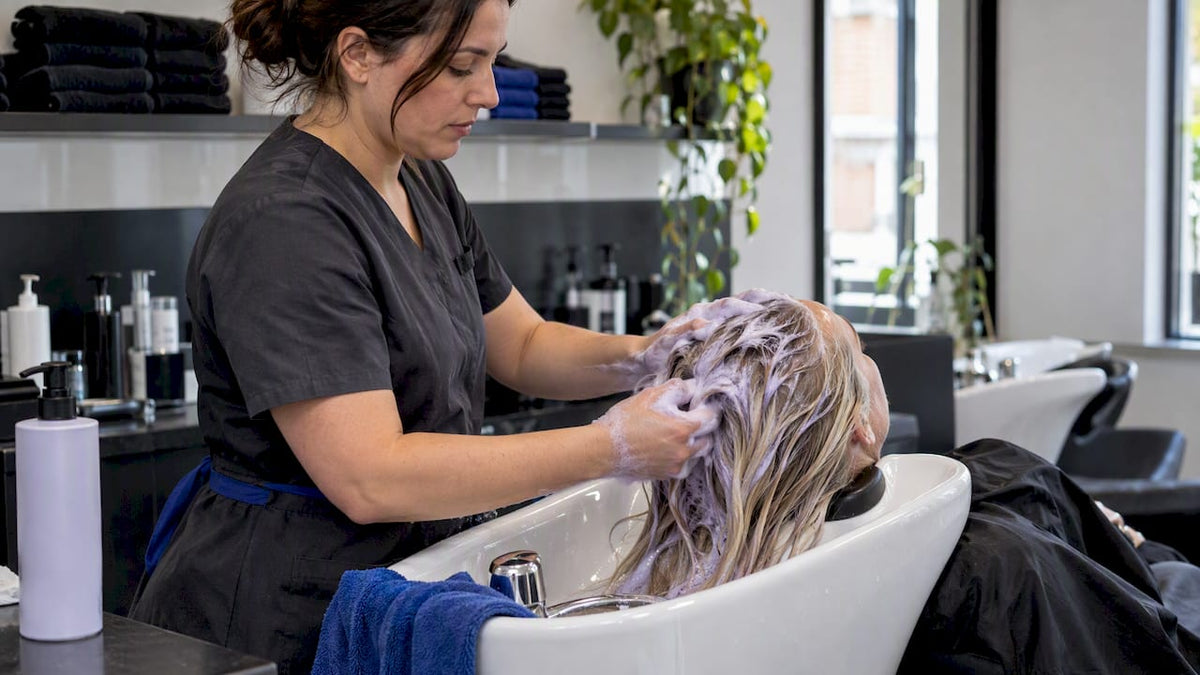
- Wet hair thoroughly, then work a small amount of shampoo into the mid-lengths and ends first, where brassiness tends to show most.
- Only work product through to the roots if your roots are noticeably brassy too; roots often need less toning than lengths.
- Follow the label’s contact time. Start at the shorter end, often 1 to 3 minutes, and only extend toward the product’s upper limit (some stronger formulas allow up to 15 minutes) once you know how your hair responds.
- If you’re nervous about overcorrection, dilute a small amount with water or mix it with your regular conditioner to soften the toning effect.
- Rinse thoroughly with cool to lukewarm water until no purple residue runs through, checking the hairline and nape where product can linger unnoticed.
Leaving purple shampoo on overnight is not something we’d recommend. Contact times on the label exist because formulas are tested to deliver a specific effect within that window, and extending it well past the recommended time raises the risk of an uneven, ashy or violet-tinted result rather than a cooler, more even blonde.
Signs of overuse and how to fix them fast
Overuse tends to announce itself quickly if you know what to look for. A lavender or purple cast through the ends, an ashy or uneven tone, or hair that looks flat and dull are the clearest visual signs. Run your fingers through it: if it feels rougher or drier than usual, that’s a tactile cue that toning has outpaced hydration.
The fix is usually straightforward:
- Rinse thoroughly with warm water for longer than usual to lift any residual pigment sitting on the hair shaft.
- Use a clarifying or chelating shampoo once to remove buildup and reset the canvas before toning again.
- Follow with a deep conditioning or bond-building treatment to restore softness and shine.
- Skip purple shampoo entirely for several washes while hair recovers.
Overuse of purple shampoo can lead to dullness, dryness and temporary violet staining, and a conservative, label-guided frequency paired with regular conditioning is the more reliable path to even tone. If irritation on the scalp persists, or if hair feels significantly weaker or breaks easily, it’s worth talking to a stylist or dermatologist rather than troubleshooting further at home. To avoid repeating the cycle, keep a simple checklist: confirm contact time before each wash, check hair condition weekly and never apply to hair that’s already dry or strained.
Aftercare and scheduling around salon appointments
Purple shampoo works best as one part of a routine, not the whole routine. Always follow it with a colour-safe conditioner or hydrating mask to replace moisture and smooth the hair cuticle, or add a light hair perfume vs body mist for a fresh scented finish. For bleached or heavily lightened hair, a weekly deep-conditioning treatment helps offset the drying effect of regular toning.
Timing around salon visits matters too. Skip purple shampoo for the week leading up to a colour appointment, since residual toner on the hair can interfere with how your stylist’s formula develops and reads.
- If brassiness returns within days of washing despite regular toning, hard water mineral buildup may be the real cause, and a monthly chelating or clarifying shampoo often solves it more effectively than toning more often.
- A simple weekly template: purple shampoo once, a hydrating mask once, and your regular gentle shampoo and conditioner on the remaining wash days.
Pro Tip: Keep a small notebook or phone note of which wash days you tone. It makes it far easier to spot patterns in brassiness and dryness over a few weeks.
ProHair product examples for a safe starter routine
We work directly with the formulas many New Zealand salons already trust, which makes it easier to build a toning routine without guesswork. If you’re starting out, Davroe Blonde Toning Shampoo is a gentle entry point, while KOBO Pure Violet and Beyond Blonde Intense Icy Shampoo suit hair that needs a stronger cooling effect.
Whichever you choose, strand-test first and follow the label’s contact time exactly.
- Buy a smaller bottle first if you’re unsure how your hair will respond.
- Test once weekly for 4 to 6 weeks before considering a second weekly wash.
- Record how your hair looks and feels each time, using our porosity test as a diagnostic step if dryness shows up earlier than expected.
Combining purple shampoo with other toning products and treatments
Purple shampoo doesn’t need to carry the whole job of keeping blonde hair cool. Pairing it with a matching purple or violet conditioner lets you reduce how long the shampoo sits on your hair, since the conditioner continues gently depositing pigment during a shorter, lower-risk step. A purple or silver toning mask once a week can serve a similar purpose for hair that needs extra conditioning alongside the colour correction.
Leave-in toning sprays and purple-tinted styling products are worth treating as light top-ups rather than replacements for a proper wash-day toning session. Using several strongly pigmented products on the same day tends to stack their effect, which is often what pushes hair from nicely cool to visibly ashy or purple-tinted.
If you’re using a bond-building or protein treatment alongside toning, it’s generally best to separate the two by a day or two. Toning right after a repair treatment can interfere with how evenly pigment deposits, since the hair’s surface is in a different state immediately after intensive conditioning. A sensible rhythm is: clarify occasionally, tone on its own wash day, and reserve richer conditioning treatments for days when you’re not also toning.

Seasonal or environmental factors affecting usage frequency
Hair care isn’t static through the year, and purple shampoo frequency shouldn’t be either. Summer sun exposure accelerates brassiness in lightened hair, since UV exposure oxidises colour faster, so you may notice yellow or orange tones returning sooner than they do in cooler months. Swimming in chlorinated pools or the ocean adds another layer: chlorine and salt both strip colour and dry hair out, which can mean more frequent toning is needed just to keep pace with how quickly warmth reappears.
Winter brings a different challenge. Indoor heating and cold, dry outdoor air both pull moisture from hair, so the same toning frequency that worked fine in warmer months can suddenly feel too drying. This is often when it’s worth stepping back to once every two weeks and leaning more heavily on hydrating masks and leave-in conditioners.
Hard water is a factor worth checking regardless of season. Mineral buildup from hard water can mimic brassiness and makes toning feel less effective no matter how often you use it, which is where an occasional chelating shampoo earns its place in the rotation rather than reaching for purple shampoo more often than your hair can handle.
Trusting a gentle, test-and-adjust approach
A toning routine that protects hair health will always beat one built for speed. Start gentle, watch how your hair responds over a few weeks, and let the results, not a fixed schedule, guide your next step. For colour correction beyond this scope, a stylist’s eye is worth the conversation.
— Burgs
Where to find salon-grade toning shampoo and conditioner
If you’d rather skip the trial and error, we stock toning formulas trusted across various salons. Browse Davroe Blonde Toning Shampoo and pair it with its matching Davroe Blonde Toning Conditioner, or explore the full shampoo and conditioner range to find the strength that suits your hair. Strand-test first, and orders over $100 ship free.
FAQ
Should I use purple shampoo every time I wash my hair?
No, most people don’t need to use purple shampoo every wash. Experts generally recommend once or twice a week, using your regular shampoo on other wash days to avoid drying hair out or over-toning it.
What does overuse of purple shampoo look like?
Overuse typically shows up as a lavender or purple tint through the hair, an ashy or uneven tone, and hair that feels rougher or drier than usual. Dullness, dryness and temporary violet staining are the most commonly reported signs, and easing off frequency for a few washes usually resolves it.
What happens if I use purple shampoo on grey or silver hair?
Purple shampoo can help cool brassy yellow tones in grey or silver hair in the same way it does for blonde hair, since the toning principle relies on neutralising warmth rather than targeting a specific hair colour. The same starting point applies: begin once weekly and adjust based on how the hair responds.
How do I know if a purple shampoo is too strong for my hair?
A formula is likely too strong if short contact times still leave a purple cast or if hair feels noticeably drier after one or two uses. Formula strength varies widely between products, so switching to a gentler formula or diluting with conditioner is often more effective than simply using it less.
Can I use purple shampoo if I have sensitive skin or scalp?
Checking the ingredient list matters if you have a sensitive scalp, since some surfactants used in shampoo formulas can be more likely to cause irritation or dryness depending on concentration and formulation. Strand and scalp testing a small amount first is a sensible precaution before committing to regular use.
Sources
- What does purple shampoo do? Dermatologists break it down — USA Today
- Purple shampoo: What does purple shampoo do? — Healthline
- EWG Skin Deep: Sodium cocoyl sulfate ingredient entry