
Retinol wins on speed and sheer weight of evidence. Bakuchiol wins on comfort. If your skin tolerates actives well and you want the fastest route to smoother, more even-toned skin, retinol is the better-studied choice. If you have sensitive or reactive skin, or you want an anti-ageing active you can wear during the day, bakuchiol is the gentler option. Whichever you choose, patch test first, introduce it slowly, and wear sunscreen daily.
TL;DR:
- Both ingredients show similar short-term improvements in wrinkles and pigmentation, but retinol works faster and has a more extensive long-term evidence base.
- Bakuchiol causes less irritation and can be used during the day due to its photostability, making it suitable for sensitive or reactive skin.
- Retinol often triggers skin dryness, redness, and increased photosensitivity, requiring gradual introduction and daily sunscreen use.
- For pregnant women or those trying to conceive, bakuchiol is generally considered lower risk, but professional advice is essential before use.
- Combining retinol and bakuchiol can be effective, but alternating nights may optimize results and minimize irritation, depending on individual skin tolerance.
Table of Contents
- What is retinol? Mechanism, benefits and side effects
- What is bakuchiol? Origin, mechanism and current evidence
- Retinol vs bakuchiol: efficacy, tolerability, speed and safety compared
- How to introduce retinol and bakuchiol without wrecking your skin barrier
- What the clinical evidence actually shows, and where it stops
- The bottom line on retinol vs bakuchiol
- Does retinol or bakuchiol help with acne and sensitivity, not just wrinkles?
- Why “natural alternative” undersells what bakuchiol actually does
- Sources
- FAQ
What is retinol? Mechanism, benefits and side effects
Retinol is a vitamin A derivative that your skin converts, through a multi-step process, into retinoic acid, the active form that binds to receptors inside skin cells. That binding switches on genes involved in collagen production and skin cell turnover, which is why retinol shows up in more anti-ageing formulas than almost any other single ingredient.
The evidence base for retinol spans decades of clinical research, covering photoageing, acne, and pigmentation. Dermatologists reach for it first partly because so much is known about how it behaves on real skin over months and years, not just in a lab.
That history comes with a cost. Retinol commonly triggers what’s called “retinisation”: dryness, flaking, redness, and stinging as skin adjusts. It also increases photosensitivity, which is why night-only application and daily SPF are non-negotiable.
Some practical points worth knowing before you buy:
- Over-the-counter retinol is available in low to moderate concentrations, while prescription retinoids (tretinoin) are stronger.
- Higher concentration doesn’t always mean better results. It usually means a rougher adjustment period.
- Retinol is not recommended during pregnancy due to vitamin A derivative concerns.
- Effects on fine lines and pigmentation generally become visible after 8 to 12 weeks of consistent use.
What is bakuchiol? Origin, mechanism and current evidence
Bakuchiol is a plant-derived meroterpene extracted from the seeds and leaves of Psoralea corylifolia, a plant used for generations in traditional practices before skincare chemists took a serious interest in it. Structurally, it has nothing in common with vitamin A. Functionally, gene-expression research shows it switches on many of the same genes retinol does, alongside antioxidant and anti-inflammatory pathways that retinol doesn’t touch in the same way.
That dual action is why bakuchiol gets called a “functional analogue” rather than a copy of retinol. It’s not mimicking retinol’s chemistry. It’s arriving at a similar cellular outcome through a different, broader route.
Clinical signals so far are genuinely encouraging: trials show measurable improvement in wrinkles and pigmentation, generally with far less irritation than retinol. Because bakuchiol is photostable, it doesn’t break down in sunlight the way some actives do, which opens the door to daytime use.
Key points on where bakuchiol currently stands:
- It suits sensitive, reactive, or rosacea-prone skin better than most retinoids.
- It can be layered with antioxidants like vitamin C without the same irritation risk retinol carries.
- The evidence base is real but considerably smaller than retinol’s decades of trials.
- Long-term data (beyond 12 to 16 weeks) is still limited, so claims about years-long outcomes stay cautious.
Retinol vs bakuchiol: efficacy, tolerability, speed and safety compared
The most cited comparison is a 12-week randomised, double-blind trial testing bakuchiol at a moderate concentration against retinol at a moderate concentration. The result surprised a lot of dermatologists: both groups saw similar reductions in wrinkle surface area and hyperpigmentation. The bakuchiol group, however, reported significantly less scaling and stinging.
That single trial is doing a lot of heavy lifting in the “bakuchiol vs retinol” conversation, and it’s worth being precise about what it shows and doesn’t show.
- Efficacy for photoageing — comparable improvement in wrinkles and pigmentation between the two, at matched 0.5% concentrations, over 12 weeks.
- Tolerability — bakuchiol caused meaningfully less irritation. Retinol’s dryness and peeling are dose-dependent and often ease after several weeks of adjustment.
- Speed — retinol has the deeper evidence base for faster, more potent change at higher concentrations or with prescription strength, though the head-to-head trial found no speed advantage at matched low doses.
- Photosensitivity — retinol requires night-only use and strict SPF. Bakuchiol’s photostability means it can reasonably sit in a morning routine.
- Pregnancy guidance — prescription retinoids are avoided during pregnancy because of vitamin A derivative risk. Bakuchiol’s mechanistic profile suggests a lower theoretical risk, since it’s less likely to activate the retinoic acid receptors linked to that risk, but the data isn’t definitive enough to call it clear.
One trial, two comparable actives, very different side-effect profiles: that’s the entire retinol vs bakuchiol debate in a sentence. Neither ingredient is a myth. Retinol simply asks more of your skin barrier to get there.
If you’re pregnant or trying to conceive, don’t self-manage this decision. Speak with your doctor or dermatologist before using either ingredient, and default to bakuchiol only with that professional’s sign-off, not as an assumed safe substitute.
How to introduce retinol and bakuchiol without wrecking your skin barrier
Most retinol disasters come from going too hard, too fast. Most bakuchiol disappointments come from giving up before eight weeks. Here’s how to avoid both.
- Patch test first. Apply a small amount behind your ear or on your inner forearm for three nights before using either ingredient on your face.
- Start retinol slowly. Begin with two nights a week, buffer with a moisturiser applied before or after the retinol, and increase frequency by roughly one night per week as tolerance builds. Use at night only, and follow with SPF every morning without exception.
- Bakuchiol has more flexibility. It can go in a morning or evening routine, and many people use it twice daily once their skin adjusts, pairing it with vitamin C or niacinamide without the irritation retinol often causes in that combination.
- Decide how you’ll combine them. Alternating nights, retinol one night, bakuchiol the next, tends to preserve retinol’s potency while cutting cumulative irritation. Layering both on the same night risks additive irritation unless the formulas are specifically designed for combination use.
- Know when to stop. Persistent burning, swelling, or broken skin means pause the active and see a dermatologist, not push through it.
A good buffering routine matters more than the active itself in the first fortnight. A rich barrier-support treatment like the Replenish Jojoba Creme Treatment applied before your retinol, or an overnight hydrator such as the HIDEHERE Collagen Sleeping Mask, gives your skin barrier something to hold onto while it adjusts. The same buffering logic that protects hair during a colour or chemical treatment applies here: support the barrier first, introduce the active gradually.
Pro Tip: Apply your retinol to fully dry skin. Damp skin absorbs actives faster and deeper, which is exactly why it also increases irritation. Wait a full ten minutes after cleansing before applying.
For a broader framework on introducing actives without triggering a reaction, this gentle skincare process guide and this safe skincare routine breakdown both walk through frequency ramping and patch-testing in more depth.
What the clinical evidence actually shows, and where it stops
The strongest piece of evidence remains the randomised, double-blind 12-week trial directly comparing bakuchiol at a moderate concentration to retinol at a moderate concentration, which found comparable results on wrinkles and pigmentation with far fewer side effects in the bakuchiol group. Supporting that, narrative reviews on gene expression confirm bakuchiol activates retinol-like pathways while adding antioxidant activity retinol lacks.
The honest summary from the research: bakuchiol performs like a gentler retinol in the short term, but nobody has run the twenty-year studies that back retinol’s reputation.
What’s still missing: larger sample sizes, trials running longer than 12 to 16 weeks, and testing across more diverse skin types and tones. Retinol’s advantage isn’t that it works better cell-for-cell. It’s that we’ve watched it work, in study after study, for far longer.
- One head-to-head trial is strong evidence, but it’s much less extensive than decades of accumulated data.
- Bakuchiol’s anti-inflammatory action is well documented mechanistically, less so in long-term outcome studies.
- Retinol’s side-effect profile is thoroughly mapped; bakuchiol’s rare adverse reactions are still being catalogued.
The bottom line on retinol vs bakuchiol
Pick bakuchiol if your skin flags every active you try. Pick retinol if your skin tolerates actives and you want the most documented anti-ageing results available. Either way: sunscreen daily, patch test first, and check with a doctor if you’re pregnant.
Does retinol or bakuchiol help with acne and sensitivity, not just wrinkles?
Photoageing gets most of the attention in this comparison, but both ingredients show up in acne and sensitivity conversations for genuinely different reasons.
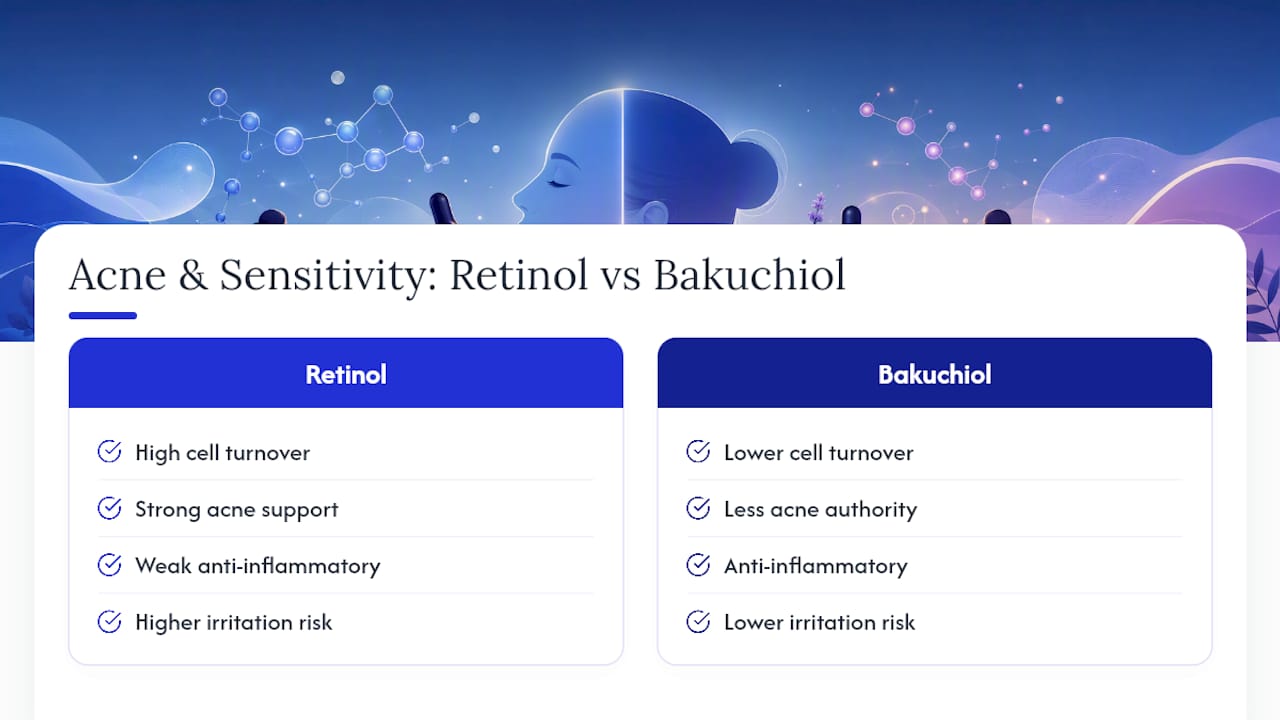
Retinol’s cell-turnover effect is why it appears in acne treatments long before anti-ageing became the marketing angle. Faster turnover means pores clog less easily, and retinoids remain a standard dermatological tool for comedonal acne. The trade-off is the same one that shows up with photoageing: irritation, and irritation on already-inflamed acne-prone skin can make redness worse before it improves.
This is where bakuchiol’s positioning shifts. Its anti-inflammatory action makes it a genuinely useful option for people whose skin reacts to almost everything, including rosacea-prone and eczema-adjacent skin types that flare under retinol. It won’t clear active acne with the same authority retinol has, but it can sit in a routine alongside acne treatments without adding fuel to the irritation those treatments already cause.
For sensitive skin specifically, the practical answer is straightforward: bakuchiol lets you chase anti-ageing benefits without triggering the reactive cycle of redness, peeling, and product avoidance that often derails a retinol routine in its first month. That’s not a lesser outcome. For a lot of skin types, it’s the only outcome that’s sustainable long enough to actually work.
Why “natural alternative” undersells what bakuchiol actually does
The framing that bugs me most in this conversation is “bakuchiol, the natural alternative to retinol.” It’s not wrong exactly, but it buries the more interesting story: bakuchiol isn’t a workaround for people who distrust actives. It’s a bioactive compound with its own mechanism, tested in a real randomised trial against retinol, that happened to come out gentler without coming out weaker.
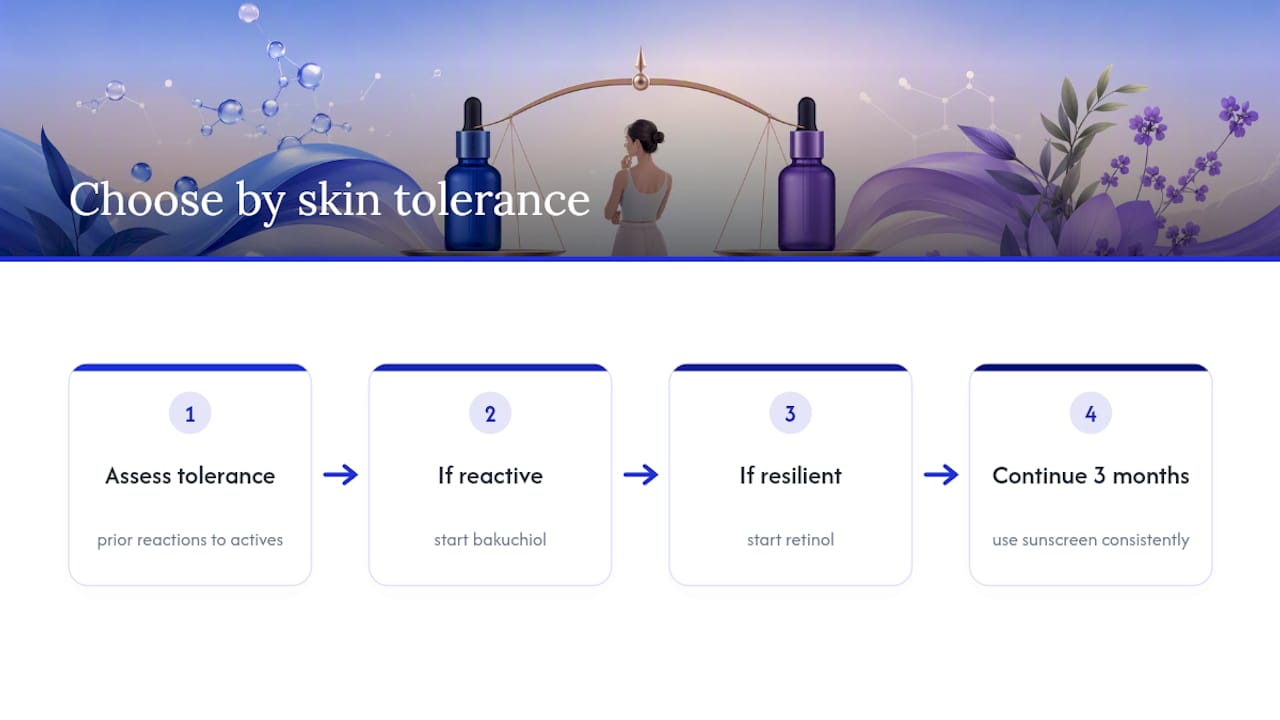
Conventional advice tends to treat this as a binary loyalty decision, retinol camp or bakuchiol camp, when the more useful question is sequencing. Start with what your skin can actually sustain for three months, because the ingredient you abandon in week two delivers zero results regardless of its evidence base. That’s the practical failure mode nobody talks about: retinol’s superior data means nothing if irritation gets you to quit before week eight.
If your skin has ever reacted to actives before, start with bakuchiol and build a tolerance baseline. If it’s proven itself resilient, retinol’s deeper evidence base makes it the better long-term investment. Either path only works with consistent sunscreen and patience measured in months, not days.
— Burgs
This article is general information, not a substitute for advice from a qualified doctor. Consult a qualified healthcare professional about your own circumstances before acting on anything here.
Sources
- Prospective, randomized, double‑blind assessment of topical bakuchiol and retinol for facial photoageing
- Bakuchiol: what to know (Cleveland Clinic)
- Narrative review: bakuchiol in dermatology (PMC)
- Human skin aging and the anti‑aging properties of retinol (Biomolecules review)
FAQ
Is bakuchiol better than retinol?
Neither is universally “better.” A head-to-head trial found comparable results for wrinkles and pigmentation, but bakuchiol caused significantly less irritation, making it the better pick for sensitive skin while retinol suits those chasing the most well-documented, potent results.
What do people use instead of retinol for gentler results?
Bakuchiol is the most researched gentler alternative, acting on similar gene pathways to retinol while adding antioxidant benefits and remaining stable in daylight.
What are the potential downsides of using bakuchiol?
Its evidence base is smaller and newer than retinol’s, long-term data beyond about 16 weeks is limited, and it may work more slowly for people who need aggressive intervention rather than gradual improvement.
Is bakuchiol safe to use during pregnancy?
Bakuchiol’s mechanism suggests a lower theoretical risk than retinoids, but the data isn’t definitive, so pregnant or trying-to-conceive readers should get personalised advice from a doctor before using either ingredient.